

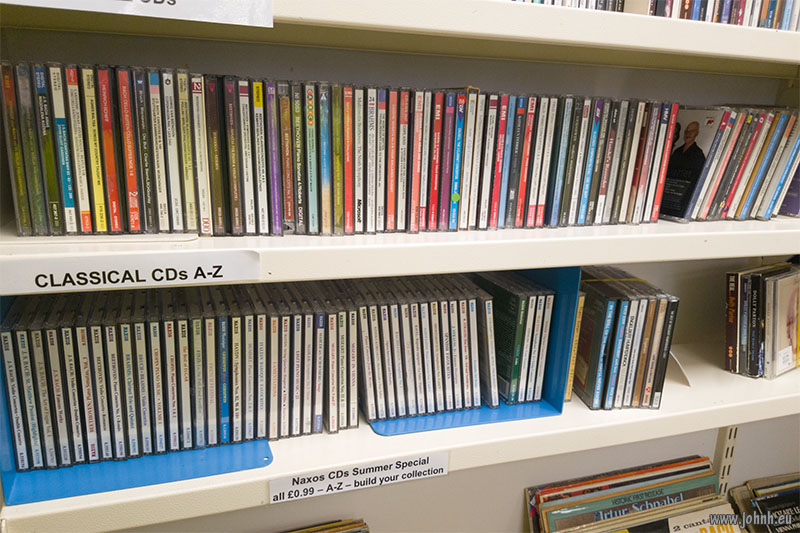
I visited the Keswick Oxfam shop on my way to buy local bread and milk. Keswick’s charity shops have beguiled me on many occasions and have provided pretty things to gather dust as well as useful stuff. Sometimes called Keswick’s department stores, they are famous as places to browse, especially on a wet afternoon when it’s not worth hiking any more: the shop is dry and their stock is generally good quality and interesting. This time I got “caught” by new stock of classical CDs. Here are my thoughts on trawling through some other music collector’s trove.
The Oxfam shop had had new stock of used classical CDs arrive, priced attractively, mostly at 99 pence per disc. It was clear on the shelf what was the new stock. The problem was what not to buy. So strange the feeling of looking over what must have been a donation of classical CDs from a collection. Great to be able to reuse these discs that had been chosen and cherished but impossible not to start thinking about whose these were. Music is personal in a way that the other stuff sold in charity shops is not. The collector was presumably local, maybe retired to the Lake District. Male or female? My instinct is male but I can’t justify it. I think a reader of The Gramophone more than Hi-Fi News. Mozart onwards. Some twentieth century music - Shostakovich Tenth. Finzi and Bridge but no Britten or Walton nor Tippett. No Bach either, not even the Brandenbergs, surprisingly, maybe the inheritors removed those before sending the rest to the charity shop or maybe they had sold already.
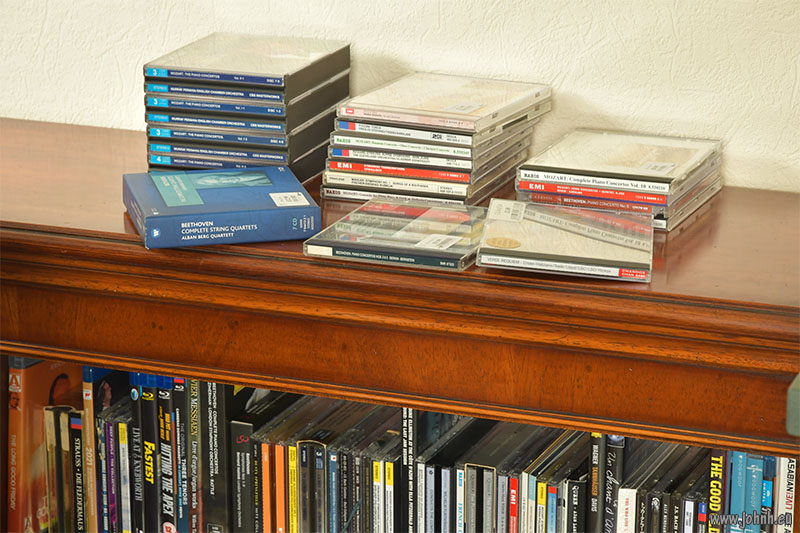
A second visit resulted in another haul, a second pass through that person’s discarded collection. I went back for the four different versions of Beethoven’s “Emperor” Piano Concerto, including a monumental performance by Rudolf Serkin and the New York Philharmonic, conducted by Leonard Bernstein in 1962.
The collector evidently bought CDs of recordings from the Sixties, presumably enjoying the benefits of digital remastering. The Sixties and early Seventies was a golden era for classical music recording, the technical aspects of stereo recording had been mostly perfected and the market was large enough that the record companies could afford to be generous with studio and rehearsal time; the result being that the performances which ended up cut to discs were likely to be single takes with only very limited patch editing.
Possibly the collector, having retired to Cumbria and having lesser access to orchestral concerts, bought again on CD performances previously enjoyed on LPs. Notable also by absence are any performances benefitting from the rising enthusiasm for period instruments and performing practice.
As well as individual discs and a couple of Puccini operas, I bagged a set of Mozart piano concertos and a box of Beethoven’s string quartets. The Mozart was clearly played but the Beethoven Quartets set t was in almost mint condition, indicating a listening project that was not completed. One wonders why: an unwanted present, was the music too challenging or was there not time.
However these CDs came up for sale, it is a pleasure to listen now to a collection curated by a knowledgeable listener. And to support the charity shop’s causes.