

Travel
I'm lucky enough to travel a lot but I also aim to understand a place in some depth. So I like to find out about the local history, sociology, wildlife and local arts. I prepare for a trip by looking up photos of the famous sights, they're usually a good guide both about the local visual interest and also a warning of what has already been done or over-done.
I try to use the tools of modern photojournalism and photography to communicate how I feel about a place. You’ll see that I have used Portrait, Street, Interior, Historical, Abstract, Landscape, Historical, Wildlife, Phone-camera and Selfie genres at different times for specific effects.

St. Tropez, now the village port where people come to be noticed. The trouble is that when everybody is a somebody then nobody is an anybody, or at least everybody who thinks they are somebody just because they are in St. Tropez at the end of a sunny Saturday afternoon in summer. So everybody has to try really hard to be noticed. Never mind the arms race in cars, yachts or wearable bling, it's fascinating how the pedestrians front out potential collisions on the narrow pavements. A not-bad dance troupe doing back-flips gets no attention whatsoever... And of course it's one of those places where the gendarmes (remember the 1964 comedy film with Louis de Funès: “The Gendarmes of St. Tropez”?) enforce a dress code that is quaintly body-fascist: you are much more likely to get asked to cover up if you are a) old or b) fat, especially b).

Marseille is changing, the old stuff like the Vieux Port and the faintly anachronistically named “Opera Municipal” are as iconic as ever, but the town is being regenerated by new installations like the Ombrière (architect: Norman Foster); a simple concept - a sunshade with a mirror finish but as popular as it is practical. Also simple innovations like the boat service between the Vieux Port and Pointe Rouge. Organised by RTM, the city transport network, and charged at five Euros, it must be one of the best value boat rides on the Mediterranean; they also do tram rides, metro rides and buses! Meanwhile, the demolition sites provide a fascinating post mortem glimpse of the inside of some of old Marseille.
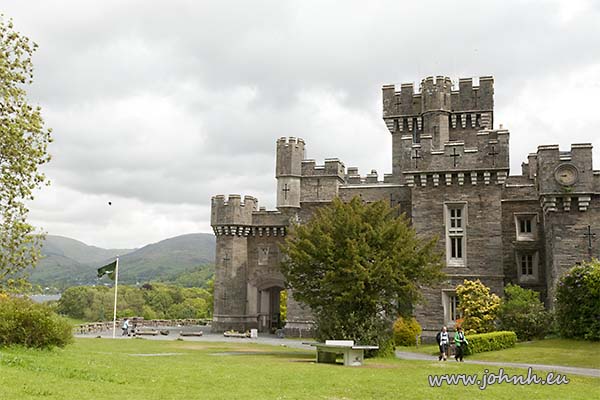
Wray Castle is now open to tourist visitors thanks to the National Trust. A Victorian gothic revival folly on the west bank of Lake Windermere that is best reached by boat from Ambleside or Windermere; Wray Castle has long since lost its original furniture and most of its fittings: fireplaces, lamp fittings etc. so the National Trust has installed a number of children’s playrooms, intended to stimulate the imagination. There’s also an adventure play area outside in the woodland.
Wray Castle estate includes some quiet coves and beaches on the lakeside, hugely reminiscent of Arthur Ransome’s “Swallows and Amazons” novels. The Windermere launches passing nearby add to the atmosphere. Yet the National Trust’s play installations so far don’t include any reference to John, Susan, Titty and Roger (Swallows) and Nancy and Peggy (Amazons) and Captain Flint, their uncle Jim… Not forgetting Keswick’s excellent “Theatre by the Lake” production last year of “Swallows and Amazons” adapted for the stage by Helen Edmundson and Neil Hannon.
This matters because the outdoor adventurism of the “Swallows and Amazons” characters balances in the canon of Lake District interest the anthropomorphic cuteness of the Beatrix Potter animals (Peter Rabbit, Mrs Tuiggy-Winkle and friends) or the “I wandered lonely as a cloud” bookiness of the William Wordsworh literary legacy.

First stage of our 750km round trip on the regional rail network of Provence:
Our week on the regional rail network of Provence started from the mainline terminus station of Marseille St. Charles. We had arrived here a few days previously after a journey of just four and a half hours from on a TGV from Lille.
Our first day’s ride was of a similar duration but took us to the clear air of Briançon in the Provence Alps on the border with Italy. Our TER (Train Express Régional, and mostly said as letters T E R, like T G V) pulled out and quickly left the big line. By the time it had left the suburbs of Marseille, the line was single track and passing large quarries and mineral treatments works before arriving at Aix-en-Provence.

Second stage of our 750km round trip on the regional rail network of Provence
Leaving the Vauban fortress walls of Briançon surrounded by snow-capped mountain at every turn, we took the TER (regional train) back down the valley of the river Durance through a dramatic gorge, passing the episcopal city of Embrun and the huge lake of Serre-Ponçon, bordered by the town of Chorges where we enjoyed a bike camp in the summer of 2012.
Our route branched from the route up from Marseille at Veynes-Dévoluy, one of those strange little towns that suddenly became important when the railway arrived because of its location at a railway junction, for Veynes-Dévoluy it is the junction between Marseille, Grenoble, Valence and Briançon.
